


The landscape of digital media has completely broken open. We are no longer just watching videos; we are witnessing the birth of a multi-billion-dollar synthetic ecosystem where autonomous software constructs entire interactive realities on the fly. From pro-filmmakers blending physical footage with advanced spatial control engines to faceless affiliate networks farming billions of views with intentionally absurd characters, the AI video landscape is moving at breakneck speed.
Data captured across global platforms reveals an undeniable truth: enterprise spending on AI video platforms has grown by a staggering 127% year over year. What used to be a playground for experimental tech enthusiasts has matured into a hyper-efficient, high-stakes ecosystem. Whether you are an advertiser racing against rapid creative fatigue, an educator looking to scale classroom content, or a creator fighting to maintain an organic audience, understanding these shifting paradigms isn’t just an asset; it’s a survival requirement.
This comprehensive deep dive explores the core technology, localized market variations, aggressive commercial monetization frameworks, and the cultural friction points defining the state of AI video generation.
The Frontier of Core AI Video Engines
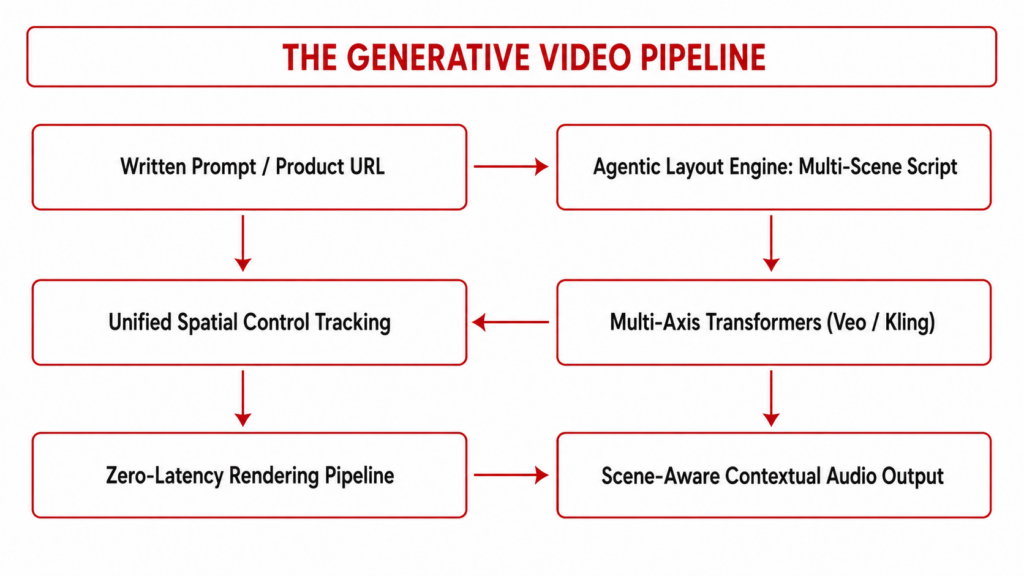
The underlying engineering powering video synthesis has progressed far beyond the simple, choppy text-to-clip animations of the early generative era. Today’s systems are built on massive-scale transformer architectures capable of sophisticated environmental mapping, physics calculations, and unified media deployment.
The Rise of Agentic Video Directors
The conversation has shifted radically from writing the “perfect prompt” to deploying autonomous agents that act as writers, directors, and editors all at once. The global rollout of advanced tools like the Google Flow Agent has set off an explosive tech trend. Instead of generating a single clip and manually modifying it, creators use built-in conversational agents to handle complex multi-scene planning.
These agents can interpret a narrative concept, map out a sequence of logical shots, and perform simultaneous batch-style and color corrections across multiple assets via basic natural language.
Spatial Control and Character Consistency
For years, the Achilles’ heel of AI video was temporal continuity, faces changed between frames, backgrounds warped randomly, and product logos distorted. The latest operational rollouts, specifically within OpenAI’s Sora 2 architecture, are tackling this via advanced spatial control parameters.
Creators are now leveraging script configurations that lock a specific 3D render (like a branded consumer product) into precise perspective lines while generating entirely new background environments around it. By separating the background environment layers from the core object, systems achieve stable character and asset fidelity across shifting frames.
From Flat Assets to Interactive World Models
Long-term software architecture discussions are heavily focusing on the evolution of video engines into Interactive World Models. Instead of rendering a static file that plays linearly from second $0$ to second $10$, developer previews point toward responsive, multiplayer simulation environments. These world models construct visual frames dynamically in real time, reacting immediately to user input or viewer movement.
This infrastructure blurs the line between video production and video game engine architecture, signaling an inflection point at which video becomes an interactive, navigable digital space.
Contextual Audio-Visual Integration (AV-Sync)
The industry is rapidly pivoting away from the legacy workflow of retrofitting music and sound effects onto silent AI footage. Emerging engines, such as those powering Kling 3.0, are introducing native, model-level scene-aware audio generation.
When a video frame is rendered, the model simultaneously outputs synchronized, directional soundscapes that match the lighting shifts, speed fluctuations, and physical collisions occurring within the frame. This unified generation cuts post-production times in half and dramatically enhances short-form viewer retention.
The Global Valuation and Commercial Infrastructure
The macroeconomic indicators surrounding this sector prove that AI video is no longer a speculative bubble; it is a massive driver of corporate capital re-allocation.
Market Growth and Dominant Segments
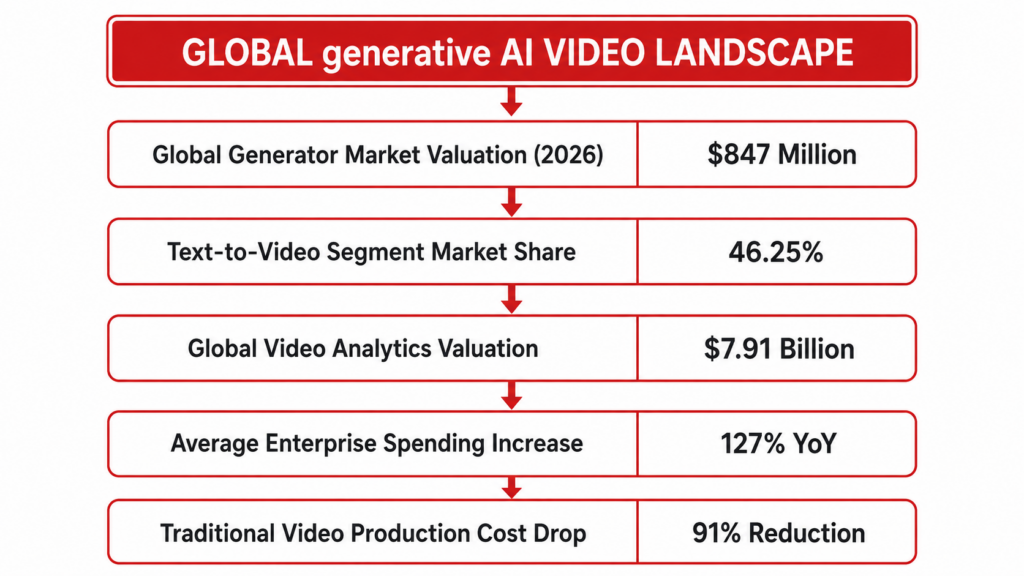
According to global financial records, the AI video generator market size has reached $847 million, with annual growth driven largely by adoption in programmatic corporate marketing. Within this generative ecosystem, the text-to-video segment maintains a dominant 46.25% market share. This shows that enterprises prioritize converting written scripts directly into multi-platform visual content over manual asset modifications.
Concurrently, the global AI video analytics market has surged to a massive $7.91 billion valuation, pushed by intense commercial demand for automated behavioral tracking, retail store optimization, and intelligent surveillance workflows.
The 91% Production Cost Collapse
The primary driver of enterprise adoption is the sheer economic displacement of traditional media creation. Creative directors are highlighting whitepapers showing that traditional high-end video production, which historically averaged $4,500 per minute for filming, crew, editing, and studio rentals, has collapsed to roughly $400 per minute when executed via automated AI tools.
This 91% cost reduction has completely shifted the barrier to entry, allowing small- to medium-sized enterprises (SMEs) to produce multi-channel campaigns that match the asset volume of legacy Fortune 500 brands.
Zero-Latency Hardware and Timeline Integration
The transition from slow, queue-based cloud rendering to local, immediate production is being accelerated by hardware breakthroughs. The announcement of pipelines powered by NVIDIA’s Blackwell GPUs and TensorRT has brought real-time AI B-roll generation directly inside editing suites like Adobe Premiere. Video editors can generate complex environmental sequences natively in their timeline without rendering delays. This emphasis on zero-latency processing is heavily backed by venture capital, as seen in Reactor’s recent $59 million funding round aimed at eliminating rendering queues.
Hyper-Velocity Video Marketing & Social Advertising
In the hyper-competitive arena of paid acquisition and organic media placement, AI video tools have transformed from an optional creative luxury into an operational defense mechanism.
Battling Meta’s Algorithm and Creative Fatigue
Performance marketers are facing a brutal reality on social ad networks. Meta’s updated delivery algorithms now penalize creative stagnation after an ad receives only 4 views from a single user. This rapid decay has caused immense financial strain on traditional agencies, giving rise to a trend known across digital marketing hubs as #MetaCreativeFatigue.
To survive, agencies are using automated creation hubs to meet the newly required benchmark of outputting 2 to 4 distinct video ads per week. Media buyers have evolved from traditional static designers into curators of high-volume automated creative pools, utilizing systems that can instantly scrape a raw product URL and output 10 distinct video hooks and narrative configurations.
Pollo AI and URL-to-Video Workspaces
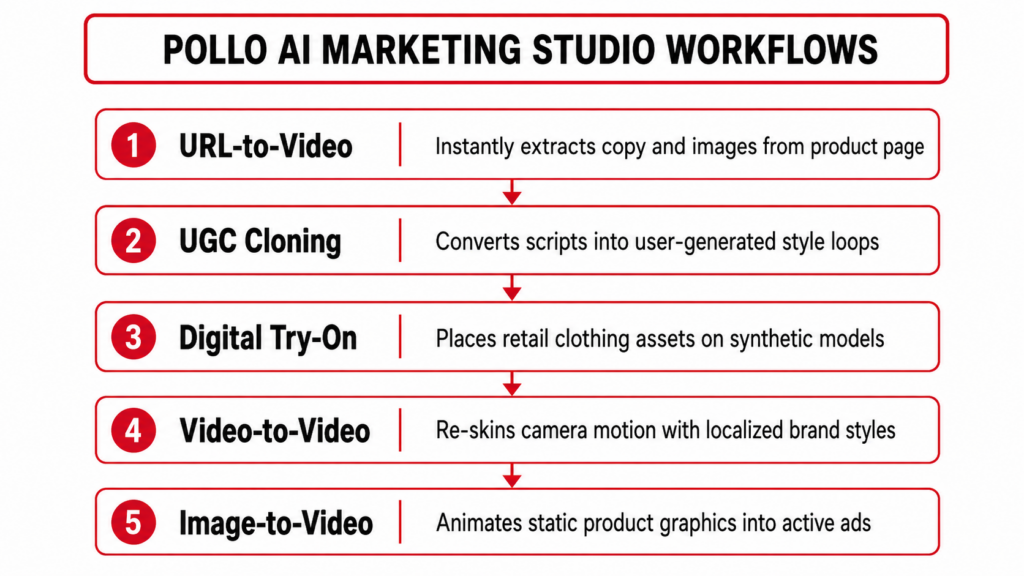
The speed of direct-response asset creation reached a new milestone with the release of the Pollo AI Marketing Studio. The platform’s five core automated workflows, including URL-to-video, UGC cloning, and digital try-on ad layouts, allow drop-shippers and small business owners to transform a standard e-commerce store link or a flat image into a high-converting vertical video ad in under 60 seconds. This eliminates the traditional friction of custom prompt engineering, making high-velocity asset scaling accessible to non-technical users.
Digital Twins and Hyper-Realistic B2B Avatars
In the B2B enterprise sales sector, traditional text-based cold outreach response rates are falling. Consequently, brands are replacing generic email sequences with programmatic personalized video loops. Platforms like Synthesia and HeyGen allow enterprise sales operations to clone a single sales rep’s voice and face, programmatically deploying 10,000 customized video messages that greet prospects by their first name and reference their specific company.
Furthermore, the introduction of advanced translation frameworks means these avatars don’t just clone vocal tones; they morph their mouth phonemes to match target international regional accents perfectly, enabling rapid cross-border market expansion.
The Global Phenomena of “AI Slop” and Brain-Rot Monetization
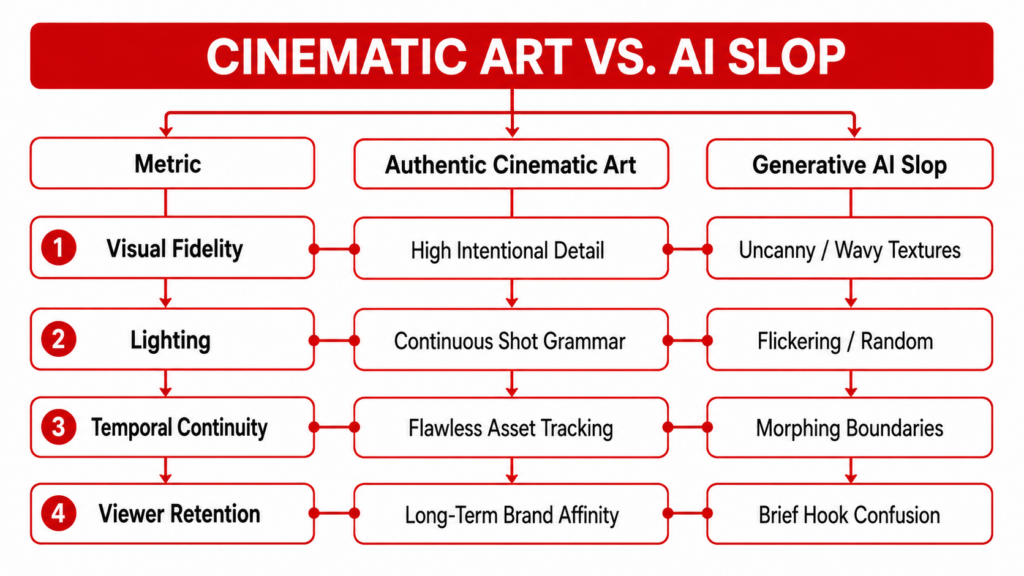
As generative tool deployment costs drop to near zero, an intense cultural and economic conflict is brewing on public social feeds between high-quality creative art and low-effort, automated algorithmic trash.
The Multi-Million Dollar “Tung Tung” Loop Economy
A massive investigative feature exposed an underground economy that has stunned the digital media world: the rise of the Brain-Rot Millionaires. Anonymous creator networks are leveraging high-velocity automated scripts to mass-blast hundreds of thousands of low-effort, deeply absurd AI-generated video characters such as the viral Tung Tung Tung Sahur and Amir looping sequences across TikTok, YouTube Shorts, and Instagram Reels.
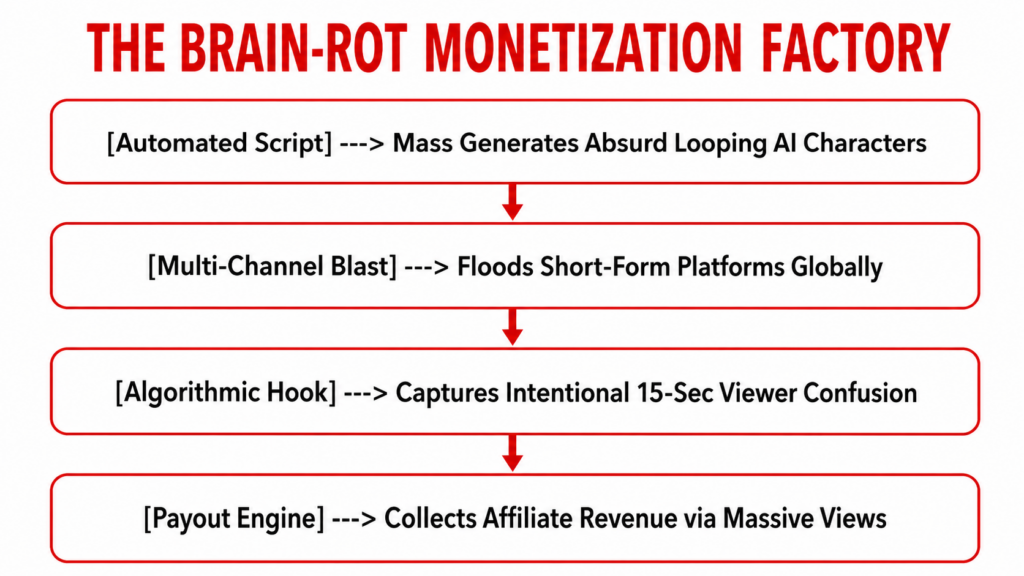
These networks exploit platform monetization funds by paying remote creators roughly $2 per thousand views to keep automated loops running continuously. Performance marketers have noted that narrative confusion, floating items, and gravity-defying visual bugs actually hook consumer attention for 15 seconds longer than highly polished, traditional corporate footage, turning algorithmic distraction into massive affiliate profit.
The Dead Internet Backlash and Boardroom Slop
This immense volume of synthetic content has sparked renewed cultural anxiety around the Dead Internet Theory. Fresh research indicates that up to 21% of all algorithmic video recommendations now actively push low-quality, bot-generated “view-farming” loops, thereby squeezing human-curated media out of organic feeds.
This tension broke into corporate mainstream tech circles following a massive backlash against a keynote presentation video containing a bizarre, entirely AI-generated techno-anthem. Creators and tech commentators widely labeled the clip as “boardroom slop,” arguing that unhinged, uncanny-valley generative aesthetics have officially breached high-level corporate spaces.
Platform Algorithmic Penalties and Mandatory Labeling
In response to rising consumer frustration, major social media networks are introducing defensive countermeasures. Advanced computer vision models are being deployed to scan and automatically apply intrusive “Altered/Synthetic Content” labels to photorealistic generative clips before they play.
Faceless content operators and brands that deploy unlabeled AI ads are experiencing sudden, immediate drops in algorithmic visibility and account penalty marks. This compliance crisis has forced marketing legal teams to scramble to update their metadata pipelines to ensure alignment with platform policies and evolving FTC guidelines on deceptive advertising.
Regional Intelligence & Market Variations
The adoption of generative video tools is not uniform; different regions are applying these technologies to serve distinct economic realities, regulatory environments, and cultural demands.
North America & Europe: Infrastructure and Enterprise B2B
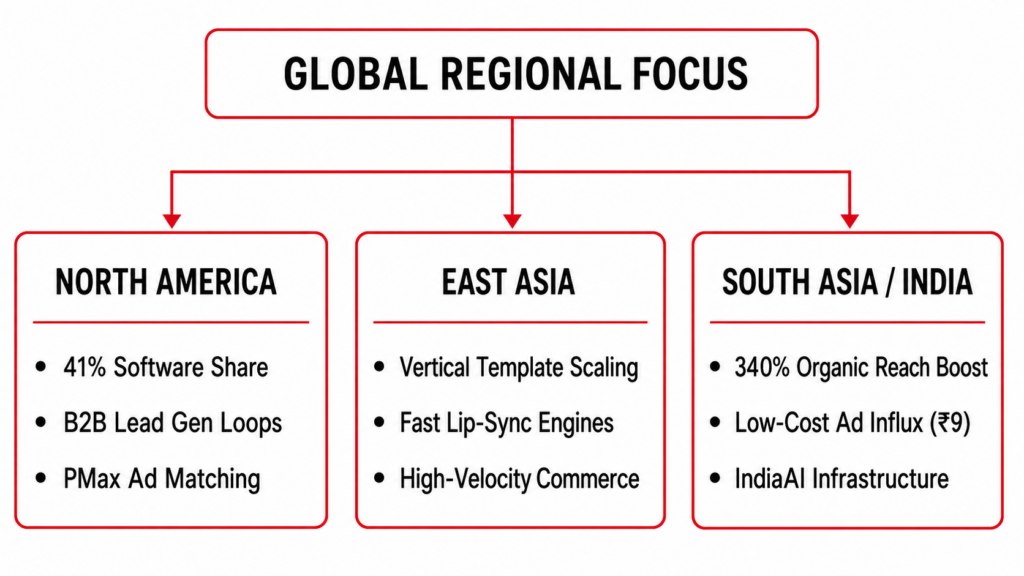
The North American venture ecosystem continues to hold a dominant 41% of the infrastructure and software market share for text-to-video platforms. Strategists here are heavily focused on data integration and maximizing search performance. For example, brands are combining Google PMax and AIAX tools to automatically construct responsive multimedia videos that answer complex, long-form user search queries on the fly.
On the compliance side, intense scrutiny around deepfakes is driving researchers to crowdsource extensive video studies of natural human facial positioning and blink metrics to train next-generation anti-fraud filters.
East Asia: Agility and High-Velocity Video Commerce
In East Asia, the focus is entirely on speed, vertical-format social media video optimization, and rapid localization. Content creation hubs have driven a massive surge in usage for frameworks like Kling AI, leveraging rapid version updates to build seamless vertical templates.
This agility has triggered a massive expansion in Hyper-Velocity Video Commerce, where generative AI creative suites are linked directly with interactive in-app store checkout interfaces. This integration has delivered documented 120% conversion spikes across regional social channels.
South Asia & India: Zero-Studio Production and Public Policy
The Asia-Pacific region holds a dominant 31% share of the global AI video generator market, with India serving as a primary engine of growth. Local digital agencies and startups are achieving massive scaling metrics, documenting a 340% boost in organic reach by replacing expensive physical recording spaces with zero-studio content pipelines. Brands are taking static asset folders directly out of Google Drive and feeding them into multi-model generators to build ad variations instantly.
This boom has also triggered localized cultural friction, specifically on regional tech subreddits, where a massive influx of hyper-repetitive ₹9 AI “workshop” video ads that promise career hacks but merely upsell expensive repackaged video courses is being mocked. Concurrently, public framework developments under the governmental IndiaAI Mission are building structural public-private partnerships to scale secure, responsible, multi-lingual local translation video pipelines for public education.
The AI Video Study & Gig Economy Workflow
The rapid expansion of the AI video ecosystem has simultaneously birthed a brand-new freelance economy and transformed academic research habits.
Academic Acceleration via Video Summarizers
Faced with overwhelming volumes of remote lecture material and tight project deadlines, students are widely adopting AI Video Summarizers. Rather than sitting through multi-hour lecture recordings, researchers deploy specialized software that ingests the full audiovisual file and instantly produces comprehensive text outlines, nested mind maps, and interactive flashcards. This shift optimizes cognitive bandwidth, allowing students to process complex academic material at a highly accelerated rate.
Human-in-the-Loop Micro-Tasking
Behind every high-performing video model sits a massive army of remote gig-economy workers training the systems. On crowdsourcing research platforms like Prolific, micro-taskers monitor a steady stream of algorithmic task drops, paying roughly $5 per task to evaluate side-by-side AI video generation.
These human-in-the-loop validation studies require users to rate physics stabilization, human motion accuracy, and lighting continuity. When automated platform bugs occur, extensive independent freelancer subreddits mobilize immediately to troubleshoot account access and coordinate data logs.
Bypassing “Tutorial Hell” in the Creator Economy
As more people enter the freelance space, professional business analysts are issuing warnings about a phenomenon known as #TutorialHell. LinkedIn and YouTube career strategists highlight that studying pure technical prompt engineering or code scripts in isolation yields no sustainable freelance income.
The market has become saturated with basic prompt tips. Real economic value has shifted to operators who design comprehensive, problem-first business frameworks, such as building automated video customer service desks, scaling localized corporate training modules, or setting up multi-channel ad operations.
Conclusion: Navigating the Synthetic Media Era
We have reached a definitive turning point where video can no longer be viewed as an unalterable record of physical reality. It has become fluid code programmable, infinitely scalable, and increasingly autonomous. As the metrics show, the convergence of text-to-video dominance (46.25% market share), massive cost reductions (down to $400/min), and real-time generation frameworks means that the velocity of content creation will only continue to accelerate exponentially.
For enterprises and individual creators alike, the line between success and failure in this new landscape depends entirely on strategic positioning:
- Embrace Agentic Workflows: Move past basic, one-off clip generation. The future belongs to those who integrate multi-clip autonomous agents to handle script, layout, batch editing, and contextual audio in a single loop.
- Prioritize OrganicAuthenticity. Public social feeds are hard by generic, bot-generated “AI slo,;” human audiences are developing a defensive filtering mechanism. Incorporating realistic film grain, natural skin textures, light imperfections, and cohesive shot grammar will yield significantly higher audience retention.
- Maintain Strict Compliance Tracking: With platforms introducing strict auto-detection synthetic media labels and the FTC monitoring deceptive advertisements, brands must build metadata transparency directly into their creative operations to prevent sudden algorithmic shadowbans.
The generative video landscape is no longer about predicting what the technology will be able to do down the road. The engines are live, the capital flow is massive, and the algorithms are actively rewriting the rules of global attention right now. The only question left is whether you will build the automated infrastructure to scale with it, or find your brand buried beneath the synthetic wave.
Gen-AI Video Revolution: FAQs
What Is The Gen-AI Video Revolution?
The Gen-AI video revolution refers to the rapid shift from traditional video production to AI-powered video creation, where generative models can produce, edit, localize, and personalize videos at scale using text prompts, images, scripts, or product URLs.
How Are AI Video Generators Changing Content Creation?
AI video generators are reducing production time, lowering costs, and enabling creators, brands, educators, and agencies to produce large volumes of video content without relying on traditional studios, crews, or long editing workflows.
What Are World Models In AI Video?
World models are advanced AI systems that can simulate interactive visual environments rather than simply generating fixed video clips. They allow video content to respond dynamically to user input, movement, or real-time interaction.
Why Are World Models Important For The Future Of Video?
World models are important because they blur the line between video, gaming, virtual production, and interactive media. They could transform passive video watching into immersive, navigable, and responsive digital experiences.
What Is Agentic Video Creation?
Agentic video creation uses AI agents that can act like directors, editors, and production assistants. These agents can plan scenes, arrange shots, apply edits, manage visual style, and generate multiple video variations from a single creative brief.
How Does AI Solve Character Consistency In Video Generation?
Modern AI video systems use spatial control, reference locking, and asset consistency techniques to keep faces, products, characters, and branded objects stable across multiple frames and scenes.
What Is AI Slop?
AI slop refers to low-quality, mass-produced AI-generated content created mainly to attract views, exploit algorithms, or generate revenue. It often includes strange visuals, repetitive loops, unrealistic motion, or absurd characters.
What Are Brain-Rot Loops In AI Video?
Brain-rot loops are short, repetitive, highly addictive videos designed to capture attention quickly. In AI-generated content, these often use surreal characters, confusing narratives, and visual oddities to increase watch time on platforms like TikTok, YouTube Shorts, and Instagram Reels.
Why Is “Million-Dollar Slop” Becoming Popular?
“Million-dollar slop” is becoming popular because low-cost AI tools allow creators and affiliate networks to produce huge volumes of viral videos. Even low-effort clips can generate revenue when they achieve massive reach across short-form video platforms.
How Is AI Video Affecting Advertising?
AI video is transforming advertising by allowing brands to create many ad variations quickly. Marketers can test different hooks, formats, avatars, product visuals, and localized messages without running expensive traditional video shoots.
What Is Creative Fatigue In Social Media Advertising?
Creative fatigue happens when audiences see the same ad too many times and stop responding to it. AI video helps brands fight creative fatigue by generating fresh ad variations faster and more affordably.
How Are AI Avatars Used In B2B Marketing?
AI avatars are used in B2B marketing to create personalized sales videos at scale. Companies can clone a salesperson’s face and voice, then generate thousands of customized outreach videos for different prospects, industries, or regions.
How Does AI Video Reduce Production Costs?
AI video reduces production costs by replacing or minimizing the need for physical locations, camera crews, actors, studios, editors, and reshoots. Brands can generate videos from scripts, images, product pages, or existing assets.
What Is URL-To-Video Generation?
URL-to-video generation allows users to paste a website or product page link into an AI tool, which then automatically creates a promotional video using the page’s images, text, product details, and selling points.
How Is AI Video Changing The Creator Economy?
AI video is making content creation more accessible, but it is also increasing competition. Creators can now produce more content faster, while platforms are becoming flooded with synthetic media, faceless channels, and automated video farms.
What Are The Risks Of AI-Generated Video Content?
The major risks include misinformation, deepfakes, copyright issues, low-quality spam content, loss of trust, platform penalties, deceptive advertising, and reduced visibility for authentic human-created media.
Why Are Platforms Labeling AI-Generated Videos?
Platforms are labeling AI-generated videos to improve transparency and reduce deception. Synthetic media labels help users understand when content has been created or significantly altered using AI tools.
How Is AI Video Being Used In Education?
AI video is being used in education to summarize lectures, create study guides, generate training videos, translate learning content, and produce interactive visual explanations for students and educators.
What Skills Are Important In The AI Video Economy?
Important skills include storytelling, video strategy, prompt design, ad testing, workflow automation, localization, compliance awareness, audience analysis, and the ability to build business-focused AI video systems.
What Is The Future Of AI-Generated Video?
The future of AI-generated video will likely involve real-time generation, interactive world models, personalized ads, multilingual avatars, automated editing agents, and stricter rules around synthetic media transparency.
