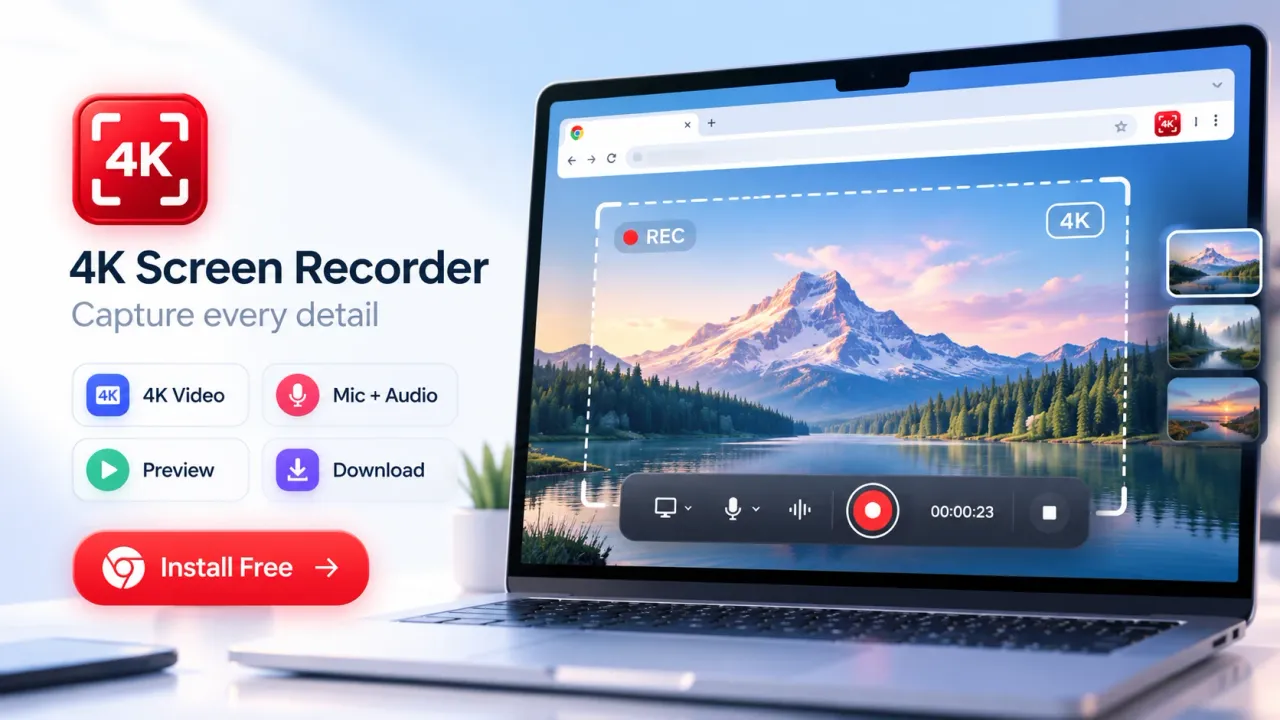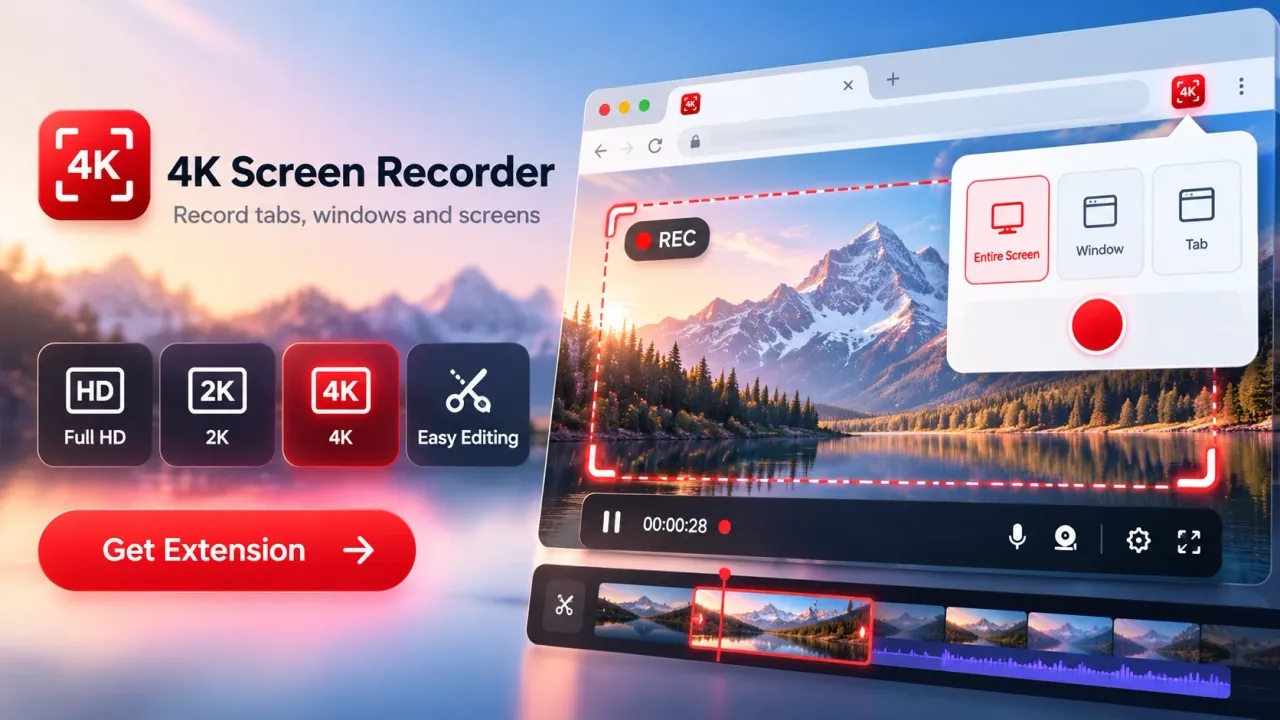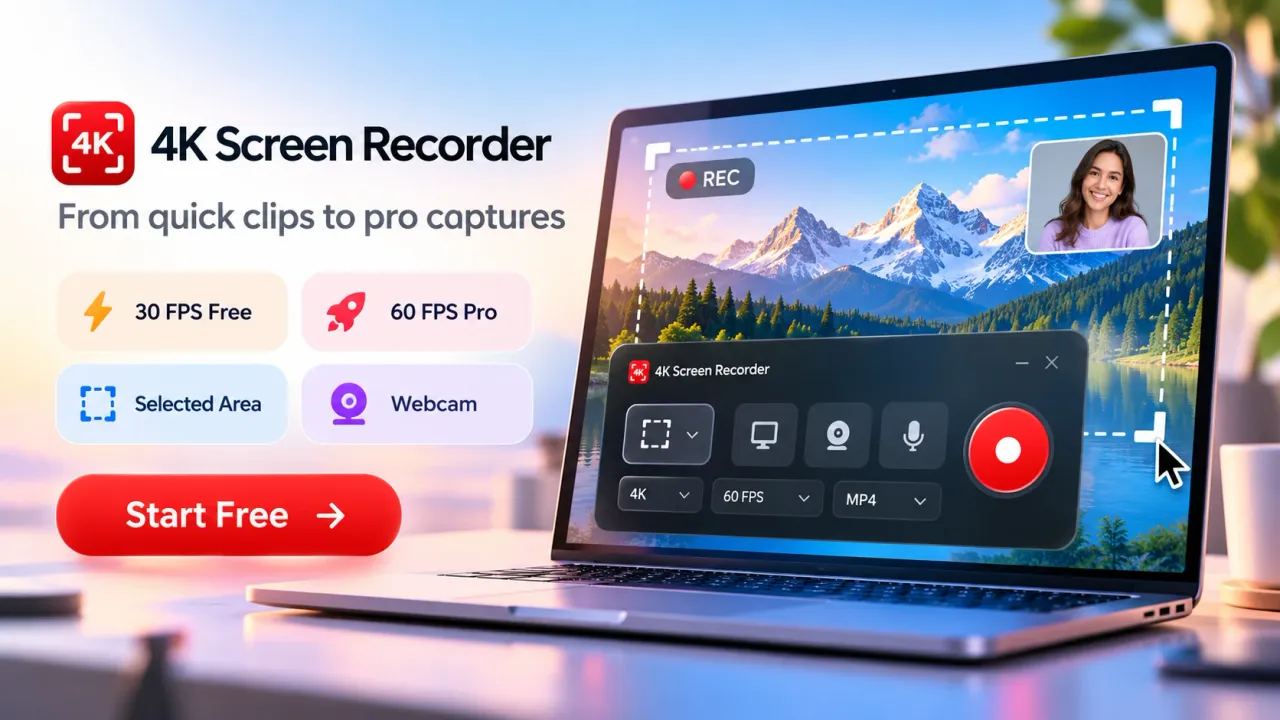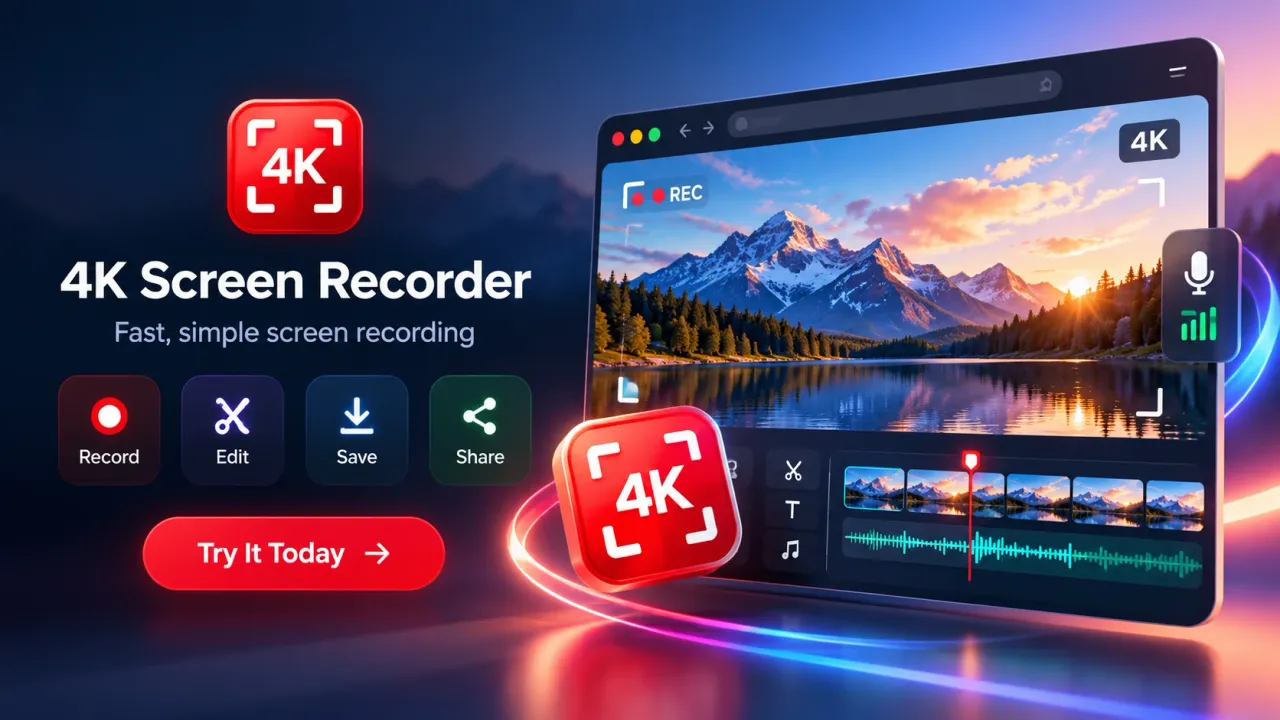

A free screen recorder for Google Chrome lets political campaign teams capture a browser tab, application window, full display, microphone narration, available computer audio, and webcam video directly through Chrome. For political campaigns, screen recording is useful for staff training, website checks, creative reviews, analytics explanations, technical issue reporting, volunteer instructions, remote coordination, and internal documentation. The current 4K Screen Recorder Chrome extension supports Full HD, 2K QHD, and 4K UHD recording at 30 frames per second on its free plan, with longer recording, 60 FPS, selected-area capture, and additional editing available through Pro. Political…
A free screen recorder for Google Chrome lets political campaign teams capture a browser tab, application window, full display, microphone narration, available computer audio, and webcam video directly through Chrome.
For political campaigns, screen recording is useful for staff training, website checks, creative reviews, analytics explanations, technical issue reporting, volunteer instructions, remote coordination, and internal documentation.
The current 4K Screen Recorder Chrome extension supports Full HD, 2K QHD, and 4K UHD recording at 30 frames per second on its free plan, with longer recording, 60 FPS, selected-area capture, and additional editing available through Pro.
Political campaign work now depends heavily on browser-based systems. Campaign staff use websites, advertising dashboards, analytics tools, shared documents, social platforms, research systems, online forms, creative review pages, and communication tools throughout the day. Screen recording converts those digital actions into video instructions or records that other team members can review later.
A campaign manager can record a website change and send it to field coordinators. A digital analyst can explain campaign metrics while displaying a dashboard. A creative lead can record feedback on an advertisement. A volunteer manager can demonstrate how to access approved campaign material. A technical team can receive a recording that reproduces a website problem exactly as it appeared.
The value comes from showing both the action and its order. Screenshots show individual moments. A screen recording can show cursor movement, menu choices, page changes, audio, timing, and the sequence needed to complete a task.
Why Screen Recording Fits Modern Political Campaign Work
Screen recording gives political campaigns a practical way to explain digital processes without requiring every team member to attend the same call or receive lengthy written instructions. It works particularly well for repeatable browser tasks, training, approvals, technical reporting, and internal communication.
Political campaigns commonly operate through several teams at once:
- Campaign leadership
- Political strategists
- Digital advertising teams
- Social media teams
- Content and creative teams
- Data analysts
- Website and technical teams
- Constituency coordinators
- Volunteer managers
- Research teams
- External consultants and agencies
Each group can work with different tools and permissions.
A screen recording creates a common visual reference. The person making the recording can show the exact interface, explain the reason for each action, and provide context that can be difficult to communicate through text alone.
Screen recording also supports asynchronous campaign work. A district coordinator does not need to schedule a live meeting simply to learn how to complete a routine browser task. The coordinator can watch an approved recording and replay specific sections.
Political teams should still keep formal records for decisions, approvals, spending, compliance, and campaign administration where required. A recording is useful documentation, but it does not automatically replace formal campaign records.
Quick Facts About Chrome Screen Recording for Political Campaigns
Chrome screen recording combines browser capture, audio, optional webcam video, local processing, and video export into a workflow suited to short digital campaign tasks.
Key facts include:
- 4K Screen Recorder can capture a Chrome tab, application window, full screen, and, with Pro, a selected webpage area.
- The free version supports Full HD, 2K QHD, and 4K UHD at 30 FPS.
- Current free recording limits are 60 seconds for Full HD, 30 seconds for 2K, and 10 seconds for 4K.
- Pro removes those recording duration limits and adds 60 FPS, selected-area recording, and additional editing functions.
- Microphone narration, available tab or system audio, and an optional webcam overlay can be included.
- Recordings are processed locally in the browser and can remain in extension storage until saved or deleted.
- Optional automatic transcription can send audio to the browser's speech-recognition service after user confirmation.
- Chrome's screen-capture process requires the user to select the tab, window, or screen being shared and provides a visible recording indicator.
What a Chrome Screen Recorder Can Capture
A Chrome screen recorder captures selected digital activity rather than automatically recording every part of a computer. The user chooses the source, such as one browser tab, one application window, or an entire screen, before recording begins.
Browser tab recording is suited to work contained within one Chrome tab.
Campaign teams can use tab recording for:
- Campaign website reviews
- Landing-page checks
- Public information research
- Social media approval screens
- Browser-based reporting
- Content management demonstrations
- Analytics explanations
- Form instructions
Tab recording reduces the amount of unrelated desktop content that can appear.
Application window recording captures one selected window.
A campaign team can use window recording for a presentation, spreadsheet, design review, reporting tool, or browser window. This mode can be safer than recording a full display when private applications are open elsewhere.
Full-screen recording captures a selected display.
Full-screen mode is useful when a workflow moves between several applications. It also creates more privacy risk because notifications, messages, files, or unrelated windows can become visible.
Selected-area recording captures only a defined portion of a webpage or screen area when supported.
For political campaign work, a selected area can focus attention on a chart, advertisement preview, form, browser control, or small section of a reporting interface. The current Chrome product lists selected-area recording as a Pro feature.
Google Chrome's screen capture model is user initiated. Chrome presents a picker that lets the user choose the tab, window, or screen to record, rather than silently selecting a source.
Full HD, 2K, 4K, and Frame Rate Explained for Campaign Teams
Recording resolution determines the pixel dimensions of a screen recording, while frame rate describes how many video frames are captured each second. Campaign teams should choose both settings according to the content being shown rather than automatically selecting the highest available option.
The extension currently offers:
- Full HD at 1920 × 1080
- 2K QHD at 2560 × 1440
- 4K UHD at 3840 × 2160
The product documentation states that 4K UHD contains four times the pixel count of Full HD.
Full HD works well for many political campaign recordings. It is generally sufficient for browser instructions, website checks, short training clips, simple dashboards, and internal updates.
2K can help when a dashboard, spreadsheet, research page, or reporting interface contains smaller labels that need to remain readable.
4K is most useful when fine interface detail matters, the source itself contains enough detail, or the recording could later be cropped during editing.
Higher resolution does not repair an unclear source. Recording a low-resolution image in 4K does not create missing detail.
Frame rate affects motion.
Thirty frames per second is suitable for many browser demonstrations and presentations. Sixty FPS can make rapid scrolling, animations, moving interfaces, and motion-heavy demonstrations appear smoother.
The free Chrome plan records at 30 FPS. Sixty FPS currently requires Pro.
Performance also depends on the computer, operating conditions, browser behavior, source resolution, and other processes running on the device. The product terms explicitly state that recording performance can vary according to hardware, browser support, operating system, and the selected source.
Audio, Microphone, and Webcam in Political Campaign Recordings
Audio turns a screen capture into an explanation. Microphone narration lets campaign staff explain why an action matters, while available tab or computer audio can capture sound from approved browser content. Webcam overlays can add the speaker when face-to-camera context is useful.
Microphone narration can improve:
- Staff training
- Analytics explanations
- Creative feedback
- Technical instructions
- Website reviews
- Volunteer onboarding
- Remote briefings
A campaign analyst can display a performance report while explaining what each metric represents.
A media manager can show an approved publishing workflow while describing each required step.
A technical specialist can reproduce a website error while explaining what happened before the error appeared.
Webcam overlays are more useful when the speaker's presence adds context, such as recorded briefings or training. They are less necessary for simple bug reports or short browser demonstrations.
Campaign teams should enable only the inputs required for the recording.
Microphone access should be off when narration is unnecessary. Webcam access should remain off when no speaker video is required. Source audio should only be included when the recorded audio is relevant and authorized.
Audio availability can depend on Chrome behavior and the capture source selected.
The Best Political Campaign Uses for Screen Recording
Screen recording provides the most campaign value when a digital process needs to be shown accurately, repeated across teams, reviewed later, or documented for another person.
Campaign training
Political teams can create short tutorials showing staff or volunteers how to access approved resources, complete a browser task, update a webpage, submit information, or use an internal reporting process.
The same video can be reused by authorized team members without repeating the demonstration in several calls.
Creative review
A campaign creative lead can record a video preview, website page, advertisement draft, graphic, or landing page while explaining corrections.
Screen recording gives editors and designers a visual reference tied directly to the material being discussed.
Digital advertising checks
Campaign teams can record an advertisement preview, destination page, disclosure, creative version, or relevant setup screen as part of internal quality review.
A recording can document what a reviewer saw at a particular stage. It should not replace official platform records, approval records, or legally required campaign documentation.
Analytics walkthroughs
A campaign analyst can record dashboards while explaining traffic sources, advertising results, website activity, video results, or other approved campaign metrics.
Political teams should avoid displaying personal or voter-level information unless the viewer and recorder have authorization.
Website quality checks
Screen recording can document:
- Broken links
- Form errors
- Missing images
- Incorrect text
- Mobile or desktop display problems
- Publishing errors
- Slow interactions
- Unexpected browser behavior
A technical team can see the exact steps that produced the problem.
Remote coordination
Political campaigns can involve state teams, constituency teams, field staff, digital teams, media teams, and external partners working in different places.
Short recorded instructions can reduce unnecessary meetings for simple operational work.
Content production
A campaign can use screen capture within approved explainers, presentations, instructional videos, or demonstrations.
Public political content requires more review than an internal recording because election rules, advertising policies, permissions, and publication requirements can apply.
A Safe Screen Recording Workflow for Political Campaign Teams
A political campaign screen-recording workflow should begin with purpose and access control before recording starts. The recorder should decide what needs to be captured, who will receive the file, and whether the recording is internal or intended for publication.
A practical workflow is:
Define the purpose. Decide whether the recording is for training, analytics explanation, creative feedback, technical reporting, website review, documentation, or public communication.
Prepare the screen. Close private messages, personal email, unrelated browser tabs, password managers, financial information, donor information, voter data, confidential research, and unnecessary applications.
Choose the smallest suitable capture source. Use one tab when one tab is enough. Use one application window when the workflow stays inside that window. Record the entire screen only when the process genuinely moves across applications.
Choose recording quality. Full HD is suitable for many routine tasks. Use higher resolution when smaller interface details need to remain visible.
Enable only necessary audio and camera inputs. Turn on the microphone when narration adds value. Enable webcam video only when the speaker needs to appear.
Record in a clear sequence. Keep cursor movement purposeful. Avoid opening unrelated pages or switching between unnecessary applications.
Preview before sharing. Look for confidential information, incorrect statements, notifications, personal details, background content, audio problems, or unapproved material.
Edit where needed. Remove unused sections and join approved clips when required.
Export the recording. Save the finished file in the required format.
Move important recordings into approved storage. Browser or extension storage should not be treated as a permanent archive.
Control access. Internal campaign recordings should only be shared with people who need them.
This workflow treats recording as part of information management, not simply as a video-production task.
Built-In Editing, Trim and Stitch, Captions, and Export
The current Chrome extension includes preview and editing functions that allow users to prepare short recordings without immediately moving the file into another video editor. Free users receive basic Trim and Stitch editing, while additional editing functions are reserved for Pro.
Trim tools can remove unnecessary material from the beginning or end of a recording.
Stitching can combine several clips into one file.
The Pro feature set currently lists functions such as:
- Captions
- Text
- Shapes
- Annotations
- Overlays
- Branding controls
- Color controls
- Thumbnail tools
Optional automatic transcription uses browser speech recognition after confirmation.
Captions can help staff understand recordings when audio cannot be played.
Annotations can point toward a specific button, form field, chart, or setting.
Editing should preserve context. Political campaign recordings should not be edited in ways that create a false representation of a person, interface, statement, event, or action.
The recorder prefers MP4 where the browser supports it and can use WebM as a compatibility fallback.
Free Recording Limits and When Pro Becomes Relevant
The free Chrome extension is designed for short recordings. As of November 2026, the Chrome Web Store lists limits of 60 seconds at Full HD, 30 seconds at 2K QHD, and 10 seconds at 4K UHD, all at 30 FPS.
Those limits make the free version practical for tasks such as:
- Showing one website error
- Recording one short instruction
- Explaining one analytics metric
- Reviewing one small creative change
- Demonstrating one browser action
- Documenting a short approval item
Longer campaign training sessions require more recording time.
The current Pro offering removes recording duration limits and adds 60 FPS, selected-area recording, and additional editing tools.
Campaign teams should base the free-versus-paid decision on workflow requirements.
A team that mainly records short bug reports may not need longer sessions.
A campaign producing detailed training, multi-step tutorials, long analytics explanations, or extended website walkthroughs is more likely to need unrestricted recording time.
Privacy and Local Processing of Campaign Recordings
The Chrome extension processes screen recordings locally in the browser rather than uploading the recording itself to an external recording server as part of the normal recording workflow. Recordings can remain inside browser or extension storage for preview and editing until the user saves or deletes them.
Local processing is particularly relevant to political campaigns because recordings can expose:
- Unpublished campaign strategy
- Internal analytics
- Advertising plans
- Staff discussions
- Private dashboards
- Content awaiting approval
- Research
- Operational procedures
Local recording reduces exposure associated with automatically sending the recording to a remote recording server, but local processing does not remove other security risks.
A copied file can still be shared with the wrong person.
A device can still be compromised.
A private notification can still appear inside a full-screen recording.
A user can still expose voter information, login details, personal data, or restricted campaign material.
The Chrome Web Store currently states that the extension handles categories including personally identifiable information, authentication information, web history, user activity, and website content. The developer declares that data is not sold to third parties, is not transferred for purposes unrelated to the extension's main function, and is not used for lending or creditworthiness decisions.
Campaign technology teams should review current Chrome Web Store disclosures before organization-wide deployment because permissions, features, and disclosures can change.
Automatic Transcription Needs Separate Privacy Review
Automatic transcription is different from the core local recording workflow because the current Chrome Web Store description states that audio can be sent to the browser's speech-recognition service after confirmation.
A campaign handling confidential discussions should decide whether transcription is permitted before enabling it.
For example, an internal recording may contain strategy notes that are acceptable for local capture but not approved for processing through an external speech-recognition function.
Campaign policy should distinguish between:
- Recording locally
- Editing locally
- Saving locally
- Exporting files
- Sharing files
- Using automatic transcription
- Uploading recordings to other services
The distinction matters because each action can expose information in a different way.
Consent, Recording Rights, and Responsible Use
A screen recorder gives the user technical recording capability, but it does not grant permission to record every piece of content visible on a screen. Users remain responsible for privacy, consent, copyright, access restrictions, workplace requirements, and applicable law.
The product terms state that users are responsible for having the right to record, copy, edit, store, or share captured material. The terms prohibit recording that violates privacy, intellectual property rights, access restrictions, security controls, or applicable law.
Political campaigns should create internal rules covering:
- Meetings
- Private calls
- Staff conversations
- Paid subscription material
- Internal databases
- Donor information
- Voter information
- Advertising accounts
- Research portals
- Third-party videos
- Copyrighted audio
- Private dashboards
A recording policy should define who can record, what may be captured, where recordings can be stored, who can receive them, and when they should be deleted.
Local browser storage also requires care. The product terms warn that recordings held in local browser storage can be lost through extension removal, browser settings, device cleanup, or other system actions.
Important campaign recordings should therefore be exported and stored according to the campaign's approved file policy.
Screen Recordings Used in Political Advertising Require Additional Review
An internal campaign screen recording is not automatically an election advertisement. The regulatory position changes when recorded material is published as political advertising, especially when money is spent to distribute it or when the content falls within election advertising rules.
For campaigns operating in India, the Election Commission of India stated on March 20, 2026 that registered political parties, organizations, candidates, and relevant individuals must seek Media Certification and Monitoring Committee pre-certification for political advertisements on electronic media, including internet and social media, before publication. The same press note addressed authentic social media account information and campaign expenditure related to internet and social media activity.
The Election Commission distinguishes ordinary political content posted on self-managed accounts from advertisements in its broader guidance. Campaign teams should therefore identify whether a screen-recorded asset is internal content, organic political communication, or an advertisement before publication.
Google's current India Election Ads requirements also require eligible election advertisers to complete verification. Accounts classified for India Election Ads must provide the required pre-certificate for each relevant election advertisement.
Google currently restricts election-ad targeting to permitted categories that include geographic location, age, gender, and contextual targeting options. Verified election advertisements must also carry the required payer disclosure.
Screen recording technology does not remove these requirements. Production, legal review, platform review, and campaign approval remain separate activities.
Editing Political Screen Recordings and Synthetic Content Rules
Ordinary screen recording and routine video editing are different from alterations that falsely depict real people or events. Campaign teams should preserve the original meaning of recorded activity when editing political material.
Google's election advertising policy currently requires disclosure for election advertisements containing synthetic or digitally altered content that inauthentically depicts real or realistic-looking people or events. Examples include content that makes a person appear to say or do something they did not say or do.
Google's policy also states that routine edits such as resizing, cropping, color correction, brightness adjustment, red-eye correction, or background changes that do not create a false realistic depiction are outside that specific disclosure category.
Political campaign editors should therefore distinguish ordinary production work from edits that alter meaning.
A screen recording used for internal training may only require trimming.
A public campaign video might add approved titles and captions.
A digitally altered election advertisement can create additional platform disclosure requirements.
How to Choose a Chrome Screen Recorder for Campaign Work
Political campaign teams should evaluate a screen recorder according to operational needs, privacy, recording quality, permissions, file handling, browser performance, editing, and sharing requirements.
Research across current browser recorder tools shows that the most useful evaluation areas include:
- Recording quality
- Video and audio synchronization
- Ease of recording
- Browser performance
- Privacy controls
- Local versus remote storage
- Permissions
- Editing functions
- Sharing methods
- Recording limits
- Resolution
- Frame rate
- Webcam support
- Annotation support
- File export
- Long-session stability
Current Chrome recorder research also distinguishes short browser recording from longer professional recording sessions. Browser extensions are particularly useful for quick tutorials, bug reports, browser workflows, and short communication, while extended production can require greater editing and recording capacity.
Political campaigns should add campaign-specific criteria:
- Can sensitive information remain local during recording?
- Can staff select one tab rather than exposing a full desktop?
- Can permissions be reviewed?
- Can exported files move into approved campaign storage?
- Can the team standardize naming and retention?
- Does the recorder support the required recording length?
- Does editing preserve an accurate representation of campaign material?
The best choice is determined by the campaign process, not by maximum resolution alone.
A Practical Recording Standard for Campaign Organizations
A shared recording standard makes files easier to understand, store, review, protect, and reuse across a political campaign.
An internal standard can specify:
- Recording purpose
- Candidate or campaign name where relevant
- Constituency or project identifier
- Department
- Recording date
- Version number
- Approval status
- Standard resolution
- Microphone rules
- Webcam rules
- Notification settings
- File naming
- Storage location
- Access level
- Retention period
- Publication status
A filename might identify whether the recording is training, analytics, website review, technical reporting, or creative feedback.
Campaign teams should also distinguish drafts from approved recordings.
A video created for internal review should not be mistaken for approved public campaign material.
A published political recording should pass the campaign's required legal, policy, factual, and creative checks before release.
Current Status of 4K Screen Recorder in 2026
The Chrome Web Store listed 4K Screen Recorder version 1.9.1 as updated on October 28, 2026. At that time, the listing described the extension as free to install with optional paid Pro features.
The current free feature set includes:
- Chrome tab recording
- Window recording
- Screen recording
- Full HD recording
- 2K recording
- 4K recording
- 30 FPS
- Preview
- Download
- Trim and Stitch
The current free duration limits are:
- Full HD, up to 60 seconds
- 2K QHD, up to 30 seconds
- 4K UHD, up to 10 seconds
Current Pro features include:
- Unlimited recording duration
- 60 FPS
- Selected-area recording
- Additional editing
- Captions
- Annotations
- Overlays
- Branding controls
- Color controls
- Thumbnail tools
The Chrome product page states that recordings are processed locally in the browser. The Chrome Web Store also notes the separate automatic transcription behavior discussed earlier.
Features and limits can change as Chrome and the extension develop. The product terms explicitly state that browser compatibility, supported formats, features, and limits can change.
Where Screen Recording Adds the Most Campaign Value
Screen recording works best as a communication and documentation method for digital campaign processes. Its strongest value comes from making browser activity visible, repeatable, reviewable, and easier to explain.
For short tasks, a free Chrome recorder can cover a large range of campaign needs.
A website issue can be shown in seconds.
A volunteer instruction can be demonstrated visually.
A campaign analyst can explain one metric.
A creative manager can show one required correction.
A remote campaign worker can receive an exact browser workflow without joining another meeting.
For longer training, extended analytics explanations, or detailed production work, recording duration and editing requirements become more important.
Privacy also deserves equal attention. Local browser processing is useful, but campaign security depends on the full workflow, including what appears on screen, who records it, where the exported file is stored, who receives it, and whether optional external processing features are enabled.
A free screen recorder for Google Chrome is therefore most useful to a political campaign when it is treated as part of a defined operational process. Recording quality matters, but purpose, access control, consent, privacy, accurate editing, storage, and publication review determine whether the recording can be used responsibly.
A free screen recorder for Google Chrome can support political campaign teams with training, analytics reviews, website checks, creative feedback, technical reporting, volunteer instructions, and remote coordination.
Tools such as 4K Screen Recorder make it possible to capture browser tabs, windows, full screens, audio, microphone narration, and webcam video without relying on a separate desktop recording application.
The real value comes from using screen recording within a clear campaign process. Teams should choose the right capture area, protect confidential information, review recordings before sharing, store important files securely, and follow consent, copyright, platform, and election advertising requirements when recordings are published publicly.
For short operational tasks, the free version can cover many everyday campaign needs. Longer training videos, extended recordings, selected-area capture, 60 FPS, and advanced editing may require paid features.
Political campaigns should also recheck product limits, Chrome permissions, privacy disclosures, and election rules as they change over time.
Used with proper access control, privacy review, and publication checks, Chrome screen recording can become a practical part of modern political campaign communication and digital operations.
Free Screen Recorder for Google Chrome: FAQs
What is a free screen recorder for Google Chrome?
A free screen recorder for Google Chrome is a browser-based tool that captures a Chrome tab, application window, or full screen. Depending on the tool and plan, it can also record microphone narration, computer or tab audio, and webcam video. Political campaign teams can use screen recording for training, reporting, website reviews, creative feedback, and technical documentation.
How can political campaigns use a Chrome screen recorder?
Political campaigns can use Chrome screen recording for volunteer training, analytics explanations, website testing, campaign creative reviews, digital advertising checks, technical issue reporting, remote staff instructions, and internal process documentation. Recorded videos can also help teams explain browser-based workflows without scheduling repeated live demonstrations.
Can 4K Screen Recorder record in Full HD, 2K, and 4K?
Yes. The current 4K Screen Recorder Chrome extension supports Full HD at 1920 × 1080, 2K QHD at 2560 × 1440, and 4K UHD at 3840 × 2160. Recording quality should be selected according to the detail required, computer performance, and how the final video will be viewed.
What are the free recording limits of 4K Screen Recorder?
As covered in the current product information reviewed for the article, the free plan supports up to 60 seconds at Full HD, 30 seconds at 2K QHD, and 10 seconds at 4K UHD. The free plan records at 30 FPS. Longer recordings and 60 FPS are available through Pro features.
Can political campaign teams record microphone, audio, and webcam video?
Yes. The recorder can include microphone narration, supported browser or computer audio, and an optional webcam overlay. Microphone recording is useful for training and analytics explanations, while webcam video can be used for briefings or instructional content when showing the speaker adds useful context.
Are screen recordings processed locally in the browser?
The reviewed 4K Screen Recorder documentation states that normal screen recordings are processed locally in the browser and can remain in extension storage until they are saved or deleted. Political campaign teams should still protect exported files, device access, browser permissions, and sensitive information visible during recording.
Is automatic transcription also processed locally?
Not necessarily. The current product information states that optional automatic transcription can send audio to the browser's speech-recognition service after user confirmation. Campaign teams handling confidential strategy, private discussions, voter information, or restricted material should review this behavior before enabling transcription.
What privacy precautions should political campaigns take before recording?
Campaign staff should close private messages, personal email, password managers, donor information, voter data, confidential research, and unrelated applications before recording. Teams should also select the smallest suitable capture area, disable unnecessary microphone or webcam access, review the finished video, and store recordings only in approved locations.
Can a political campaign publish a screen recording as an election advertisement?
A screen recording can be used as part of political content, but publication and paid promotion can trigger election advertising rules and platform requirements. In India, political advertisers may need Media Certification and Monitoring Committee pre-certification for applicable electronic and social media advertisements. Advertising platforms can also require advertiser verification, disclosures, and other election-ad controls.
When should a campaign use the free version instead of Pro?
The free version is suitable for short tasks such as showing a website error, demonstrating one browser action, explaining a single metric, or recording a brief creative correction. Pro becomes more relevant for longer training videos, extended analytics walkthroughs, selected-area recording, 60 FPS capture, captions, annotations, overlays, and additional editing functions.